Website: https://lernu.net
Facebook: https://www.facebook.com/lernu.net
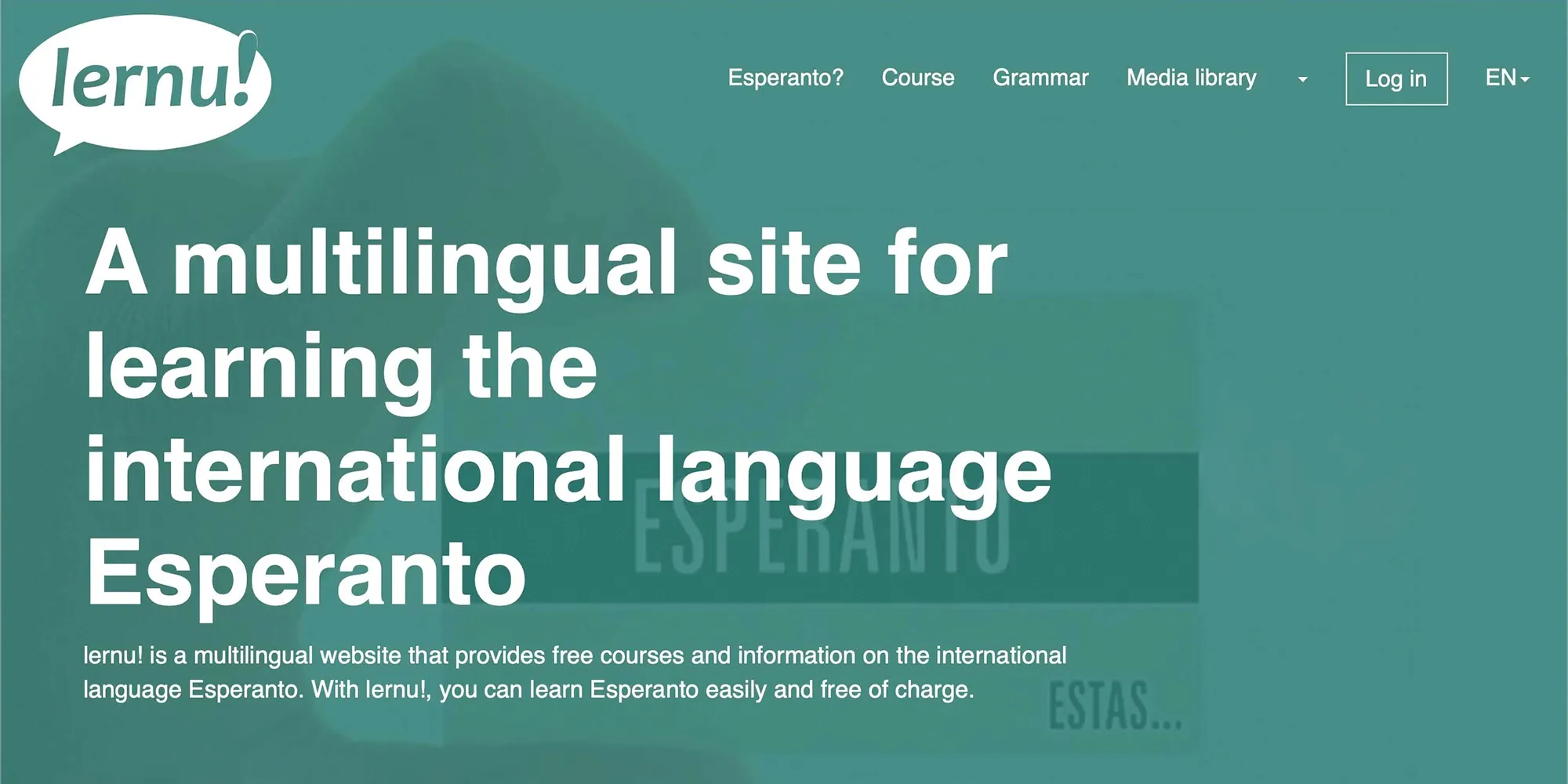
If you are curious about Esperanto and you enjoy well designed learning platforms, chances are high that you have seen lernu! before. lernu! is a multilingual, web based and completely free project for promoting and teaching Esperanto. The name comes from the verb lerni and its imperative form lernu, which simply means learn.
The project is active on social media as well, including a long running Facebook page where course updates and community stories appear.
What you find on lernu.net today
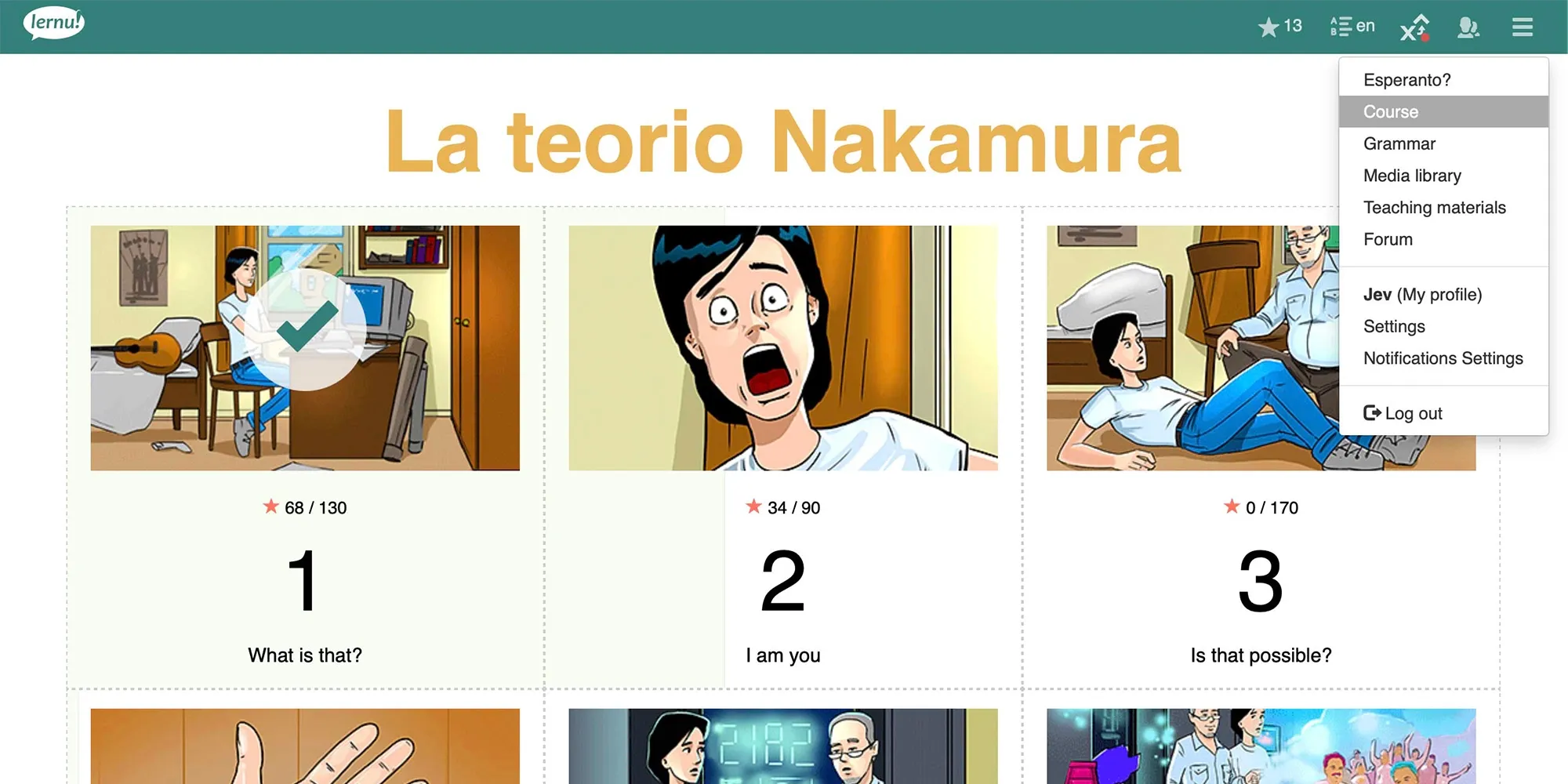
Open lernu.net and you step into a multilingual learning environment built over more than two decades. The site brings together the main course La teorio Nakamura, a twenty-six-lesson science fiction story by Anna Löwenstein, with hundreds of interactive exercises and illustrations. Alongside it, learners can find a full Esperanto grammar reference, a multilingual dictionary integrated into all course texts, and introductory information about Esperanto and its speakers.
The community side is just as present. A forum lets learners and experienced speakers exchange questions and advice, and a media library offers books, songs, voice-narrated stories, and videos.
La teorio Nakamura is the backbone of the current curriculum. It guides learners from zero knowledge to independent use of the language through a story that steadily becomes more challenging. The course aligns with the CEFR framework and is designed for both self-study and classroom settings.
The lernu! interface is available in almost forty languages. Volunteers translate menus, explanations, and many exercises, helping learners follow instructions in the language they know best.
Teachers also have their own section with guidelines, handouts, and methodological notes. A standout is the Multilingualism Accelerator, a pedagogical approach that uses basic Esperanto as a model language to support later foreign language learning. This project was co-financed by the Erasmus+ Programme of the European Commission.
How the project started
The idea for lernu! took shape in April 2000 during the first Esperanto@Interreto seminar in Stockholm and developed further in October 2001 at a second seminar in Uppsala. Participants imagined a multilingual learning portal that would introduce Esperanto to people who had never seen it before.
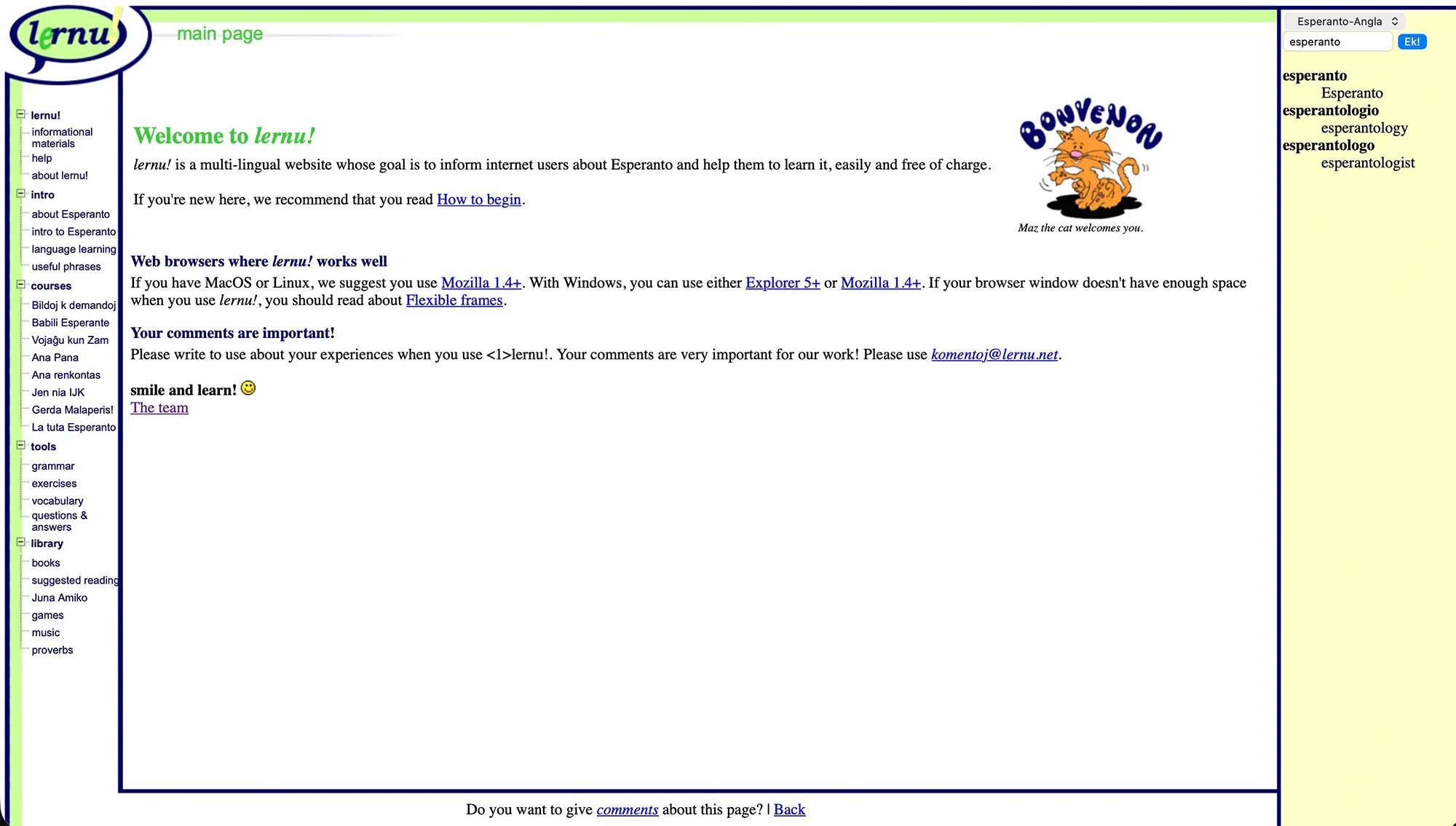
In July 2002, the Esperantic Studies Foundation (ESF) agreed to provide financial support for the idea, and development began in August. On 21 December 2002, lernu! went public. From the start, the project has been supervised and developed by the core team in cooperation with ESF, with the help of many volunteers.
The founding team brought together young activists and educators from several countries. The core members were Hokan Lundberg, Sonja Petrović Lundberg, Jevgenij Gaus, and Clayton Smith. Over the years until 2016, the group was joined at different times by Oleg Izjumenko, Bertilo Wennergren, Neringa Gaus, Erin Piateski, Peter Baláž, and Aaron Chapman.
Dozens of volunteer translators and tutors helped the site grow from a small experiment into the most widely known Esperanto learning resource on the web.
The first generation of lernu!
Visitors who used lernu! in its early days remember a very different landscape, one that was changing fast. The project expanded quickly.
Courses such as Ana Pana, Ana renkontas, Kio okazas, Jen nia IJK, Bildoj kaj demandoj, and Gerda malaperis offered structured lessons, with the option to send exercises to human tutors. At the same time, the platform added private messaging, forums, word learning tools, a “word of the day” feature, games, and an instant messenger.
Before long, lernu! had become both classroom and community.
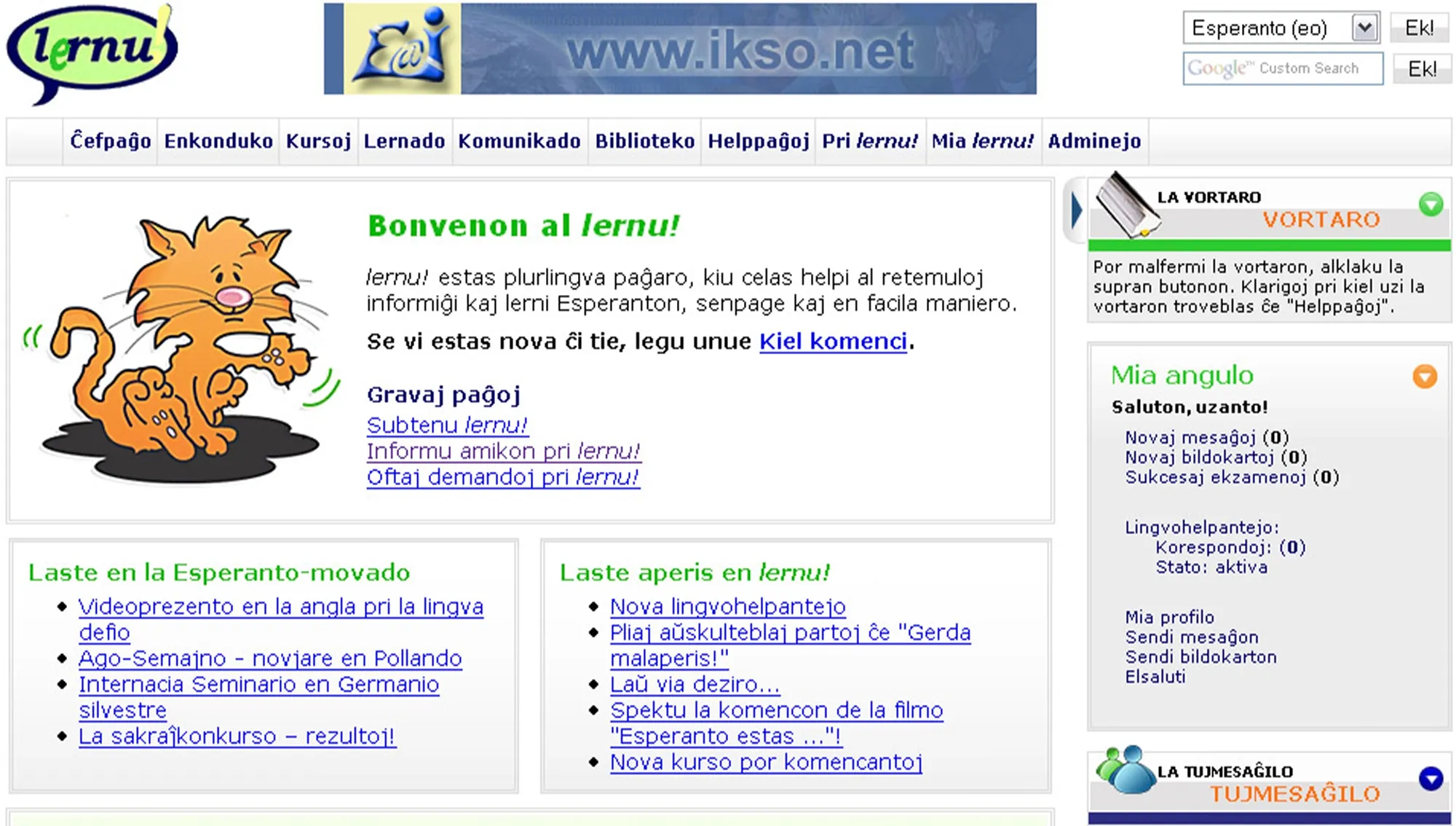
Starting in 2007, lernu! helped co organise the first Somera Esperanto-Studado (Summer Esperanto Study), an intensive summer course that later grew into a regular E@I event. lernu! played a central role in attracting participants and connecting teachers and learners who had first met online.
The numbers from this period show how quickly the platform found its audience. By mid-2007, the site counted tens of thousands of users and more than a million monthly page views, and in the following years the growth continued. By 2013, lernu! had around 150.000 registered users, and by 2018 the count had passed 300.000.
Recognition from the Esperanto world
In 2013, the Universal Esperanto Association awarded lernu! the Onisaburo Deguchi Prize, a recognition given to projects that strengthen international understanding through Esperanto. For everyone involved in lernu!, this was a meaningful confirmation of the project’s purpose.
lernu! has also been cited in academic work as an early and influential example of a multilingual online learning platform, and it has introduced Esperanto to more learners than any single offline initiative in the history of the language.
Why a complete rebuild became necessary
Over time, lernu! grew through the work of many volunteers, designers, and programmers. That brought creativity, but it also left the platform difficult to maintain. Expectations around accessibility and mobile usability had changed, and it became clear that a complete rebuild was needed to support the next decade of learning.
The plan was ambitious. We set out to create a new structure, a stronger main course, a modern design, and cleaner technology. Three main partners worked together for several years, ESF, E@I, and Studio GAUS. The goal was a platform that kept the character of the original site while meeting contemporary standards.
The 2016 relaunch and a new chapter
The new lernu! went online in summer 2016, bringing a fresh visual identity, a responsive layout, improved forums and dictionaries, and the introduction of La teorio Nakamura as the central course. Classic materials were reorganised into the new media library, so long time users could still find their favourite courses.
After the relaunch, the project moved fully under the care of Studio GAUS. Since then, we have maintained and financed the platform, working closely with E@I and ESF, and continuing the tradition of volunteer translation and community involvement.
A project that keeps teaching
More than twenty years after its launch, lernu! remains the main starting point for people looking for a structured introduction to Esperanto. It offers a flagship story course, an in-depth grammar, a multilingual interface, and a community that has grown around it.
At Studio GAUS, lernu! has been a long-standing partner and a source of experience that shaped much of our later multilingual work. What started as a seminar idea has become a global learning environment, still welcoming new generations of learners every day.